




Why SAP Warehouse Solutions Are Becoming Essential for European Warehouse Logistic
If you run a European distribution operation, you already feel the pressure: tighter delivery windows, higher labor costs, stricter traceability, and customers who expect perfect inventory accuracy. That is exactly why SAP Warehousing is moving from “nice to have” to operationally essential. Modern SAP warehouse solutions like SAP EWM connect inventory, people, and automation in real time, so you can scale across EU sites without losing control. In the Netherlands, that matters even more because it is a strategic gateway for European fulfillment.
What SAP Warehousing really means in 2026
When people say SAP Warehousing, they usually mean “running warehouse operations directly inside SAP,” not in a disconnected WMS that creates delays, re-keying, and reporting gaps. In practice, that points to SAP Extended Warehouse Management (SAP EWM), SAP’s strategic WMS designed for high-volume operations and deeper process control.
SAP EWM vs Traditional Warehouse Systems
Legacy warehouse systems often operate as standalone environments that require multiple integrations and manual reconciliation. In contrast, SAP Warehousing integrates directly into SAP S/4HANA landscapes, reducing system fragmentation and improving data integrity.
This integration enables:
- Real-time inventory visibility
- Centralized reporting
- Consistent master data governance
- Integrated transport and shipping coordination
For businesses seeking scalable SAP S/4HANA warehouse management, this tight ERP connection is a decisive advantage.
Embedded EWM in SAP S/4HANA and when it fits
A key reason SAP warehousing adoption is accelerating is tighter coupling with SAP ERP landscapes. SAP EWM is positioned to integrate complex supply chain logistics with distribution processes, giving operations teams a single operational picture. That is especially attractive if you already run SAP at the core and want fewer interfaces to maintain.
Why European warehouse logistics now demand SAP-grade control
European warehouse logistics has become less forgiving. A single stock discrepancy can trigger missed delivery slots, carrier rebooking, and customer penalties. That is why SAP Warehousing conversations are no longer only about software. They are about controlling execution, proving traceability, and running consistent processes across borders.
Real-time visibility and inventory accuracy
SAP describes modern WMS value as real-time visibility into inventory “in warehouses and in transit,” which directly maps to what EU distribution businesses need: fewer surprises, faster exception handling, and more confident promise dates.
In a practical sense, this is where RF scanning and mobile warehousing become non-negotiable. If your cycle counts, staging, and picking confirmations are delayed, your entire downstream planning becomes less reliable.
Resilience: disruptions, multi-site variability, and risk
Another recurring theme in SAP’s positioning is resilience and responsiveness, particularly when conditions change fast. When your inbound schedules shift or demand spikes, a warehouse needs to rebalance labor, prioritize urgent orders, and keep control of yard and dock flow. SAP EWM is marketed for managing high-volume operations with visibility and control, which is why many EU operations teams see it as a platform, not just a tool.
This is where 4PL becomes relevant.
A 4PL coordinates:
- Multiple warehouses
- Multiple carriers
- Cross-border compliance
- Inventory strategy
- Network optimization
Without a unified digital backbone, 4PL orchestration becomes fragmented. SAP Warehousing provides the structured execution layer that enables 4PL control.
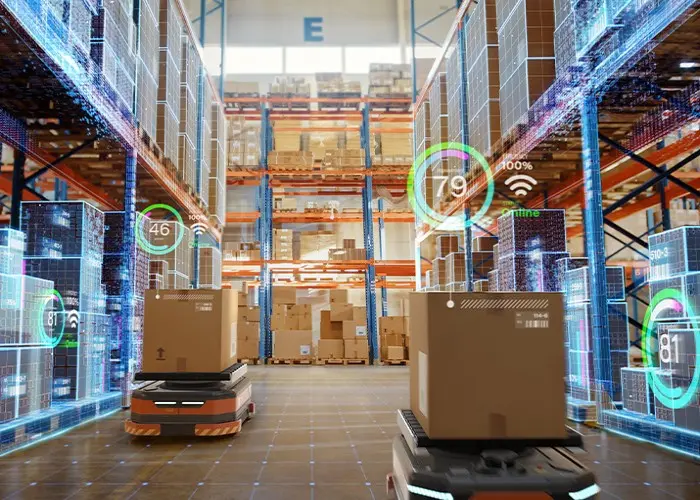
Real-Time Inventory Visibility Across Europe
SAP describes its warehouse solutions as enabling real-time inventory visibility across warehouses and in transit. For European businesses operating across Germany, Belgium, France, and Scandinavia from a Dutch hub, this unified view is critical.
Real-time data enables:
- Faster decision making
- Reduced stock discrepancies
- Better order promise accuracy
- Stronger compliance and traceability
These capabilities align directly with 4PL supply chain management Europe strategies.
Why the Netherlands is a hotspot for SAP-enabled warehousing
If you serve multiple EU markets, the Netherlands often becomes your operational “switchboard.” It is where goods enter, get stored, kitted, postponed, and redistributed. That is why Dutch SAP warehousing projects show up frequently in partner ecosystems and customer stories.
EU gateway operations and multi-country distribution
From a buyer perspective, Dutch warehousing services are compelling when they combine location advantage with execution control. If your Netherlands node feeds Germany, Belgium, France, and the Nordics, your WMS must handle multi-country order profiles, carrier constraints, and value-added services without breaking traceability.
From 3PL to 4PL: Why SAP Warehousing Enables Supply Chain Control
Many European businesses no longer want to simply outsource warehouse operations to a 3PL. They want network-level control across multiple warehouses, carriers, cross-border flows, and value-added services. That is where 4pl logistics model enter the picture.
A 3PL executes warehouse tasks.
A 4PL orchestrates the entire supply chain ecosystem.
SAP Warehousing, especially SAP EWM integrated with S/4HANA, provides the digital infrastructure that allows a 4PL to:
- Standardize processes across multiple EU warehouses
- Integrate multiple 3PL providers into one reporting structure
- Maintain real-time inventory visibility across countries
- Enforce compliance and traceability standards
- Optimize transport and yard management centrally
Without a unified SAP layer, a 4PL model quickly becomes fragmented.
Core capabilities businesses actually buy SAP warehousing for
A lot of vendor pages list features. What businesses actually pay for is control: standardized execution, fewer exceptions, and measurable productivity.
Inbound, outbound, wave, and task management
SAP EWM is positioned as an end-to-end system to support the operational value chain in warehousing. In plain terms, it lets you orchestrate receiving, putaway, replenishment, picking, packing, staging, and shipping with strong confirmation discipline.
That discipline matters in EU operations because carrier cutoffs are strict, and cross-border shipments have less tolerance for errors. SAP Warehousing becomes a way to enforce process quality consistently.
Slotting, replenishment, and labor productivity
Partners also emphasize that EWM supports optimization, not only registration. That includes better placement strategies (slotting), smarter replenishment, and controlled task assignment. It is difficult to hit service levels if your pick paths are chaotic or replenishments are late.
Warehouse automation: where SAP EWM becomes the “brain”
Automation in Europe is rising because labor is expensive and peak demand is volatile. But automation only works if the software orchestrating it can keep up.
Connecting automation and people in one workflow
SAP explicitly frames SAP EWM as a way to connect systems, assets, and people in real time, and positions it alongside AI and machine learning to improve visibility and flexibility. Even if you are not “doing AI,” the important point is orchestration: machines and humans need one shared queue and one shared truth.
Scaling automation without losing process governance
This is where governance becomes important. If you add conveyors, ASRS, pick-by-voice, or robotics, you need stable interfaces, clear exception paths, and consistent process rules. Otherwise, your warehouse becomes fast at doing the wrong thing.
Integration that reduces handoffs and surprises
One reason SAP warehousing is attractive in Europe is integration. When warehousing, transport, and parcel shipping are disconnected, your operation spends time “managing the gaps.”
Linking warehousing to transport and parcel shipping
If you ship across Europe, parcel and carrier integrations are unavoidable. SAP’s EWM extensions positioning highlights capabilities like integrating warehouse and transportation operations and managing parcel shipping. That lines up directly with the day-to-day needs of EU distribution businesses.
Extensions that add compliance, offline mode, and shipping
The same extensions page highlights quality and compliance support and even offline warehouse operation modes. For businesses with strict audit requirements, or sites with connectivity constraints, these extension options are not fluff. They are often part of continuity planning.
What to expect in cost, timeline, and ROI
You do not buy SAP Warehousing because it is trendy. You buy it because the economics of warehouse execution demands it.
Typical value levers (accuracy, speed, space, labor)
Common levers include:
- Higher inventory accuracy (fewer write-offs and fewer urgent reships)
- Faster picking and shipping (better carrier cutoff performance)
- Better space utilization (slotting and replenishment discipline)
- Labor productivity gains (task management, reduced walking, fewer exceptions)
Some external case write-ups describe improvements like speeding up picking dramatically and creating more usable space, which are typical categories of gains warehousing programs aim for.
Implementation approach that reduces risk
A stable SAP warehousing rollout is not magic. It is a sequence.
Process design, master data, and change adoption
Start with process design that matches your operation, not an “average warehouse.” Then lock master data rules, then train teams using real handheld flows. This is also why SAP highlights training orchestration as an extension area: the human layer matters.
Cutover, stabilization, and continuous improvement
Cutover should be staged around business risk: stabilize inbound first, then outbound waves, then advanced optimization. If you integrate automation, do it with strong exception paths early. Bold rule: no warehouse is “fully live” until exceptions are boring.
Conclusion
European logistics is moving toward real-time, multi-site execution where inventory accuracy and speed are not optional. That is why SAP Warehousing has become essential: it gives you a structured way to control inbound to outbound workflows, integrate automation, and maintain visibility across the network. In the Netherlands, SAP-enabled warehousing is especially valuable because Dutch sites often function as EU gateways and 3PL nodes.
The best results come when software and operating model are designed together, with strong governance and adoption. If your business needs scalable, auditable warehouse performance across Europe, SAP warehousing capability is now a competitive baseline, not an upgrade.
FAQs
What is the best SAP warehousing solution for EU distribution centers?
For most high-volume EU operations, SAP Warehousing usually points to SAP EWM because it is positioned for complex distribution workflows, real-time visibility, and automation-friendly execution.
How does SAP EWM support warehouse automation?
SAP describes SAP EWM as connecting systems, assets, and people in real time, and extensions plus interfaces can support automation workflows like pick-by-voice and system-driven task execution.
Why are Dutch warehousing services often paired with SAP?
Because the Netherlands is frequently used as an EU gateway and multi-country distribution node, companies want a robust execution layer like SAP Warehousing to keep inventory accuracy and shipping performance consistent across borders.

Author
ATOS-MARelated posts

Collaborative Logistics: Enhancing Supply Chain Optimization in Freight
In today’s interconnected world, collaborative logistics has emerged as a
Safe Transport of 12 Dangerous Goods (DG) Energy Storage units from China to Western Australia
Across the Ocean Shipping is proud to announce the successful delivery of 12 Dan

Reverse Logistics: Enhancing Sustainability through Efficient Product Returns
In today’s consumer-driven economy, product returns have become a common o
